防詐3要訣:不聽信、不操作、掛斷電話



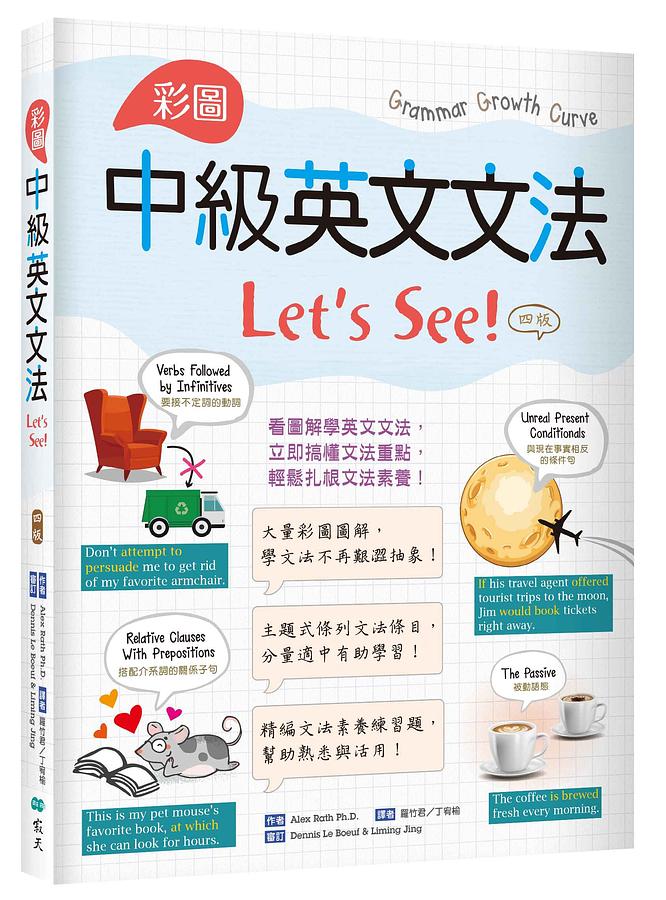
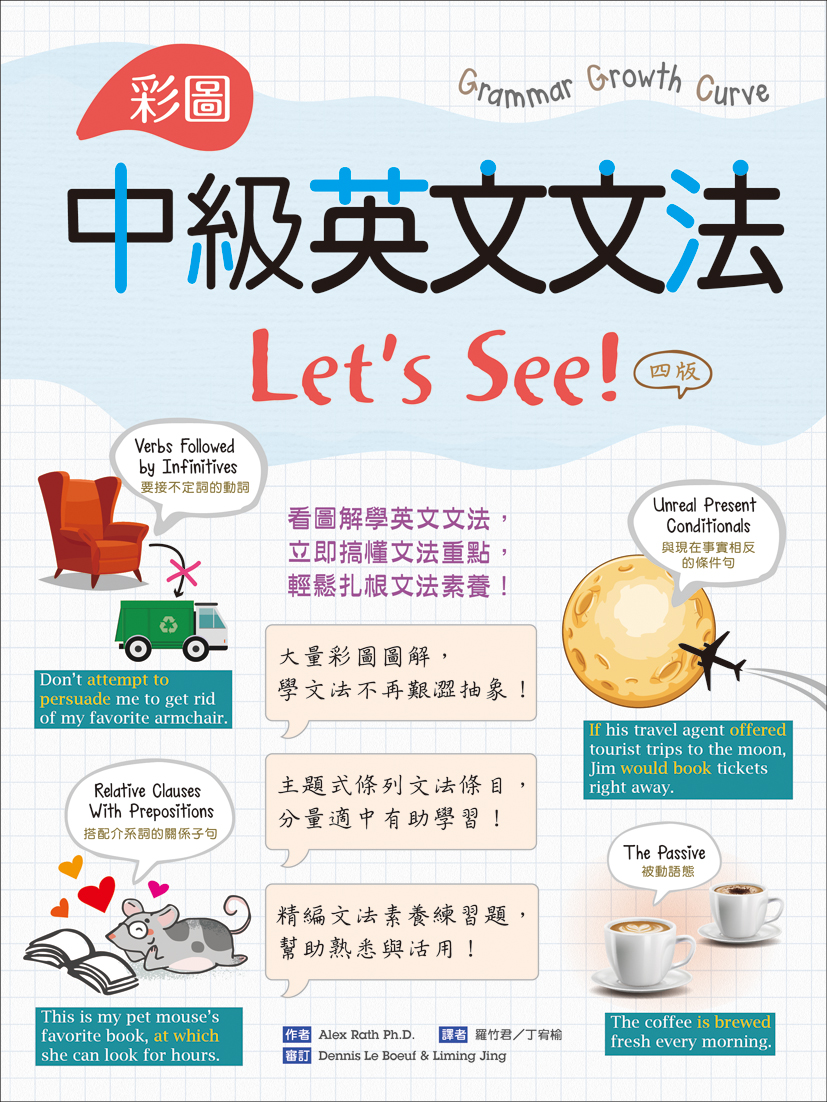
彩圖中級英文文法Let's See! (第4版/附解答別冊/寂天雲隨身聽APP)
Grammar Growth Curve
用聽的學文法,輕鬆搞懂重點,文法記憶再加強!
內容簡介
彩色圖解文法 + 例句MP3
用聽的學文法,輕鬆搞懂重點,文法記憶再加強!
本書針對初中級~中級程度者編寫,涵蓋必學的重要文法概念,適合當作英文輔助教材,供課堂上補充使用,亦可用作自修教材。條列式文法解說內容深入淺出,搭配圖解簡單明瞭,並精心設計豐富多元練習題,幫助記憶與活用,從此搞懂英文文法!
本書特點
1. 條列中級必學基礎文法
收錄中級必學的文法條目,難易度適中,並以主題式分類編排文法。循序漸進按步驟學習,讓初學者能夠輕鬆掌握核心文法概念。
2. 一頁文法一頁練習,學完立即演練,強化記憶
每單元採對頁編排,文法重點說明後,立即做練習,每單元分量適中好消化,學習進度好安排,能聚焦學習重點,也能立即檢視學習成效。
3. 列點說明好抓重點
各單元內的文法條目採條列式說明,清楚明瞭好吸收。一次搞懂一個觀念,輕鬆掌握煩雜的文法說明,不易混淆,艱澀文法也能輕易上手。
4. 彩色圖解說明文法概念
大量插圖幫助學生用圖像式記憶學習文法,輕鬆理解記憶抽象文法概念,一次掌握必學文法觀念。
5. 豐富例句幫助活用文法
文法概念編有豐富而多元的生活化例句,取材廣泛,舉凡運動、休閒、閱讀、飲食等,並用顏色標註文法重點字與解說,方便對照文法要點,理解更容易。
6. 表格分析文法要點更好懂
大量採用表格式說明、歸納重點與進行比較,讓初學者一目瞭然,有效捕捉重點資訊。
7. 大量練習活用文法好簡單
占全書一半分量的練習題,題型多元活潑,包括選擇題、填空題、改寫句子等,融入看圖作答題,透過大量練習,學會將文法運用於實際生活中,不用死背文法要點。以簡單、切中練習目標為主,幫助學生訓練與加強文法實力。
8. 聽聲音學文法,語感記憶再升級!
由專業外師錄製書中單字、片語及例句,反覆聆聽朗讀,用聽力熟悉文法規則,好背好用超難忘!
----------------------------------------------------------------------------------------------
搭配寂天雲APP聆聽訓練聽力最有效!
掃描書封QR Code下載「寂天雲」App,即能下載全書音檔,無論何時何地都能輕鬆聽取專業母語老師的正確道地示範發音,訓練您的聽力。
功能特色:
● 透過本App,可下載每本書的音檔,即點即播。
● App 內建掃描器,掃描書本內頁QR Code ,可直接對應到書本內容,播放音檔。
● 可根據自我學習狀況,設定循環播放、單曲重複播放、前進後退10秒播放。
● 有多段語速可供選擇播放,可依學習情況調整快慢語速,逐步強化聽力訓練。
● 可設定[星號書籤],標示重點複習音檔,重複播放。
● 提供背景播放,讓您無論開車、坐車通勤、跑步或行進間,訓練聽力不間斷。
● 可設定播放時間,讓您睡前也能預設關閉時間,把握淺眠期的黃金學習時段。
透過「寂天雲」App,書本與聲音的連結更自由、更多元,讓您隨時隨地都能輕鬆學習,更方便!更有效率!
產品目錄
Unit 1 Singular and Plural Nouns: Regular 單數與複數名詞:規則名詞
Unit 2 Singular and Plural Nouns: Irregular 單數與複數名詞:不規則名詞
Unit 3 Countable and Uncountable Nouns 可數與不可數名詞
Unit 4 List of Common Uncountable Nouns 常見不可數名詞表
Unit 5 Nouns Always in Plural Forms 只以複數形態出現的名詞
Unit 6 Counting Uncountable Nouns 不可數名詞的計算
Unit 7 Proper Nouns and Collective Nouns 專有名詞與集合名詞
Unit 8 Compound Nouns 複合名詞
Unit 9 Possessive 's: Forms 所有格「’s」的形式
Unit 10 Possessive 's: Use 所有格「’s」的用法
Unit 11 “The . . . Of . . .” for Possession 「The . . . Of . . .」表示「所有權」的用法
Part 2 Articles 冠詞
Unit 12 A, An 不定冠詞A、An
Unit 13 The 定冠詞The
Unit 14 Talking in General 「泛指」的用法
Unit 15 Expressions With “The” (1) 要加The的情況(1)
Unit 16 Expressions With “The” (2) 要加The的情況(2)
Unit 17 Expressions Without “The” (1) 不加The的情況(1)
Unit 18 Expressions Without “The” (2) 不加The的情況(2)
Unit 19 Place Names With or Without “The” 專有地名加The或不加The
Unit 20 Expressions With or Without “The” With Different Meanings
加The或不加The意義不同的用語
Part 3 Pronouns 代名詞
Unit 21 Personal Pronouns: Subject and Object Pronouns
人稱代名詞:「主格代名詞」與「受格代名詞」
Unit 22 Common Usages of Subject and Pronoun “It”
「主格代名詞」與代名詞It的常見用法
Unit 23 Possessive Pronouns and Possessive Adjectives
「所有格代名詞」與「所有格形容詞」
Unit 24 Reflexive Pronouns (1) 反身代名詞(1)
Unit 25 Reflexive Pronouns (2) 反身代名詞(2)
Part 4 Quantity 數量
Unit 26 Expressions for Quantity 表示「數量」的用語
Unit 27 Indefinite Pronouns for Quantity 表示「數量」的不定代名詞
Unit 28 Indefinite Pronouns With Singular or Plural Verbs
不定代名詞搭配單數動詞或複數動詞
Unit 29 “Some” and “Any” Some與Any
Unit 30 “Many” and “Much” Many與Much
Unit 31 “Few” and “Little” Few與Little
Unit 32 Both Both
Unit 33 “Either” and “Neither” Either與Neither
Unit 34 All All
Unit 35 “All,” “Every,” and “Whole” All、Every、Whole
Unit 36 “No” and “None” No與None
Unit 37 “One” and “Ones” One與Ones
Unit 38 Indefinite Pronouns With Some-, Any-, Every-, No- 以Some-、Any-、Every-、No- 開頭的不定代名詞
Part 5 Present Tenses 現在式
Unit 39 Introduction 動詞的時態介紹
Unit 40 Present Simple Tense 現在簡單式
Unit 41 Present Continuous Tense 現在進行式
Unit 42 Comparison Between the Present Simple and the Present Continuous 「現在簡單式」與「現在進行式」的比較
Unit 43 Verbs Not Used in the Continuous Forms 不能用於進行式的動詞
Unit 44 Verbs Used in the Present Simple and the Present Continuous With Different Meanings 用於「現在簡單式」與「現在進行式」意義不同的動詞
Part 6 Past Tenses 過去式
Unit 45 Past Simple Tense 過去簡單式
Unit 46 List of Irregular Verbs 不規則動詞表
Unit 47 Past Continuous Tense 過去進行式
Unit 48 Comparison Between the Past Simple and the Past Continuous
「過去簡單式」與「過去進行式」的比較
Unit 49 Continuous Forms With “Always” for Expressing Complaints
進行式搭配Always表示抱怨的用法
Part 7 Perfect Tenses 完成式
Unit 50 Present Perfect Simple Tense (1) 現在完成式(1)
Unit 51 Present Perfect Simple Tense (2) 現在完成式(2)
Unit 52 Present Perfect Simple With Some Adverbs and Prepositions
常與「現在完成式」連用的一些副詞與介系詞
Unit 53 Comparison Between the Present Perfect Simple and the Past Simple (1)
「現在完成式」與「過去簡單式」的比較(1)
Unit 54 Comparison Between the Present Perfect Simple and the Past Simple (2)
「現在完成式」與「過去簡單式」的比較(2)
Unit 55 Present Perfect Continuous Tense 現在完成進行式
Unit 56 Comparison Between the Present Perfect Continuous and the Present Perfect Simple (1) 「現在完成進行式」與「現在完成式」的比較(1)
Unit 57 Comparison Between the Present Perfect Continuous and the Present Perfect Simple (2) 「現在完成進行式」與「現在完成式」的比較(2)
Unit 58 Past Perfect Simple Tense 過去完成式
Unit 59 Past Perfect Continuous Tense 過去完成進行式
Part 8 Future Tenses 未來式
Unit 60 Simple Future “Will” 未來簡單式Will
Unit 61 “Be Going to” for the Future Be Going To表示未來意義的用法
Unit 62 Comparison Between the Simple Future “Will” and “Be Going To”
未來簡單式Will與Be Going To的比較
Unit 63 Present Continuous for the Future and the Comparison With “Be Going To”
「現在進行式」表示未來意義的用法,以及與Be Going To的比較
Unit 64 Present Simple for the Future 「現在簡單式」表示未來意義的用法
Unit 65 Future Continuous Tense 未來進行式
Unit 66 Future Perfect Tense and Future Perfect Continuous Tense
「未來完成式」與「未來完成進行式」
Part 9 Verbs: Essential Usages 動詞的一些重要用法
Unit 67 “Have” and “Have Got” Have與Have Got的用法
Unit 68 “Have” for Action Have當作行為動詞的用法
Unit 69 Be Being Be Being的用法
Unit 70 Linking Verbs 連綴動詞
Unit 71 Causative Verbs: Make, Have, Get 使役動詞Make、Have、Get的用法
Unit 72 Causative Verb: Let Let當作使役動詞的用法
Part 10 Infinitives and -ing Forms 不定詞與動名詞
Unit 73 Infinitives and -ing Forms 不定詞與動名詞
Unit 74 Verbs Followed by Infinitives 要接不定詞的動詞
Unit 75 Verbs Followed by Objects and Infinitives要接受詞再接不定詞的動詞
Unit 76 Verbs Followed by -ing Forms 要接動名詞的動詞
Unit 77 Verbs Followed by -ing Forms or Infinitives With the Same Meaning
接動名詞或不定詞意義相同的動詞
Unit 78 Verbs Followed by -ing Forms or Infinitives With Different Meanings (1)
接動名詞或不定詞意義不同的動詞(1)
Unit 79 Verbs Followed by -ing Forms or Infinitives With Different Meanings (2)
接動名詞或不定詞意義不同的動詞(2)
Unit 80 Infinitives Used as Complements and Infinitives of Purpose
不定詞當作補語與表示「目的」的用法
Unit 81 Prepositions With -ing Forms 介系詞接動名詞
Unit 82 “Need” and “See” With -ing Forms or Infinitives
Need與See接動名詞與不定詞的用法
Unit 83 Participle Phrases and Participle Clauses 分詞片語與分詞子句
Part 11 Phrasal Verbs 片語動詞
Unit 84 Phrasal Verbs: Two Words, Transitive, and Separable
片語動詞:兩個字、及物、可分
Unit 85 Phrasal Verbs: Two Words, Transitive, and Nonseparable (1)
片語動詞:兩個字、及物、不可分(1)
Unit 86 Phrasal Verbs: Two Words, Transitive, and Nonseparable (2)
片語動詞:兩個字、及物、不可分(2)
Unit 87 Phrasal Verbs: Two Words and Intransitive 片語動詞:兩個字、不及物
Unit 88 Phrasal Verbs: Three Words 片語動詞:三個字
Unit 89 Phrasal Verbs: Usages With Slight Variations in Meaning
片語動詞:不同用法細微的意義差異
Part 12 Modal Verbs (1) 情態動詞(1)
Unit 90 Modal Verbs: General Use (1) 情態動詞的一般用法(1)
Unit 91 Modal Verbs: General Use (2) 情態動詞的一般用法(2)
Unit 92 Ability: Can, Be Able To 表示「能力」:Can、Be Able To
Unit 93 Ability: Could, Be Able To 表示「能力」:Could、Be Able To
Unit 94 Permission: Can, Could, May 表示「許可」:Can、Could、May
Unit 95 Obligation and Necessity: Must, Have To 表示「義務與必要」:Must、Have To
Unit 96 Obligation and Necessity: Have to, Have Got to
表示「義務與必要」:Have To、Have Got To
Unit 97 Obligation and Choices: Mustn't, Don't Have To, Haven't Got To, Don't Need To, Needn't, Didn't Need To 表示「義務與選擇」:Mustn’t、Don’t Have To、Haven’t Got To、Don’t Need To、Needn’t、Didn't Need To
Unit 98 Obligation and Advice: Should, Ought To, Shall
表示「義務與建議」:Should、Ought To、Shall
Unit 99 Obligation and Advice: Had Better, Be Supposed To
表示「義務與建議」:Had Better、Be Supposed To
Part 13 Modal Verbs (2) 情態動詞(2)
Unit 100 Possibility: May, Might, Could 表示「可能性」:May、Might、Could
Unit 101 Possibility: Can, Should, Ought To 表示「可能性」:Can、Should、Ought To
Unit 102 Deduction: Must, Can’t 表示「推論」:Must、Can’t
Unit 103 Requests: Can, Could, May, Will, Would
表示「要求」:Can、Could、May、Will、Would
Unit 104 Offers: Will, Shall, Can, Could, Would
表示「提供幫助或物品」:Will、Shall、Can、Could、Would
Unit 105 Suggestions: Shall, Let’s, Why Don’t We, How About, What About, Can, Could
表示「建議」:Shall、Let’s、Why Don’t We、How About、What About、Can、Could
Unit 106 Habits: Used To 表示「習慣」:Used To
Unit 107 Habits: Will, Would 表示「習慣」:Will、Would
Unit 108 Other Uses of “Will,” “Won't,” and “Wouldn't” Will、Won’t、Wouldn’t的其他用法
Unit 109 “Would Rather” and “May/Might As Well”
Would Rather與May/Might As Well的用法
Unit 110 Important Uses of “Should” Should的重要用法
Part 14 Adjectives 形容詞
Unit 111 Form, Position, and Order of Adjectives 形容詞的形式、位置與順序
Unit 112 Comparative and Superlative Adjectives: Forms 形容詞比較級與最高級的形式
Unit 113 Comparative and Superlative Adjectives: Use 形容詞比較級與最高級的用法
Part 15 Adverbs 副詞
Unit 114 Adverbs of Manner 狀態副詞/方式副詞
Unit 115 Adverbs of Time and Place 時間副詞與地方副詞
Unit 116 Adverbs of Frequency 頻率副詞
Unit 117 Adverbs of Probability 可能性副詞
Unit 118 Adverbs of Degree 程度副詞
Unit 119 Adverbs “Still,” “Yet,” and “Already” 副詞Still、Yet、Already的用法
Unit 120 Adverbs “Too” and “Enough” 副詞Too、Enough的用法
Unit 121 Adverbs “So,” “Such,” “Anymore/Longer,” and “No Longer”
副詞So、Such、Anymore/Longer、No Longer的用法
Part 16 Linking Words 連接語
Unit 122 Linking Words of Time: When, As, While, As Soon As, Before, After, Until
表示「時間」的連接語:When、As、While、As Soon As、Before、After、Until
Unit 123 Linking Words of Contrast: Although, Even Though, Though, However, In Spite Of, Despite, While, Whereas 表示「對比」的連接語:Although、Even Though、Though、However、In Spite Of、Despite、While、Whereas
Unit 124 Linking Words of Reason: Because, Because Of, As, Since, Due To
表示「原因」的連接語:Because、Because Of、As、Since、Due To
Unit 125 Linking Words of Result: So, As a Result, Therefore, So . . . That, Such . . . That
表示「結果」的連接語:So、As A Result、Therefore、So . . . That、Such . . . That
Unit 126 Linking Words of Purpose: To, In Order To, So As To, For, So That
表示「目的」的連接語:To、In Order To、So As To、For、So That
Unit 127 Linking Words of Purpose: In Case 表示「目的」的連接語:In Case
Part 17 Prepositions of Place and Movement 表示地點與移動方向的介系詞
Unit 128 Prepositions of Place: Basic Meanings Of “In,” “At,” and “On”
表示「地點」的介系詞:In、At、On的基本意義
Unit 129 Prepositions of Place: “In,” “At,” and “On” With Different Locations
表示「地點」的介系詞:In、At、On說明各種地點的用法
Unit 130 Prepositions of Place: Over, Under, Above, Below, Underneath
表示「地點」的介系詞:Over、Under、Above、Below、Underneath
Unit 131 Prepositions of Place: In Front Of, Behind, Between, Among, Opposite
表示「地點」的介系詞:In Front Of、Behind、Between、Among、Opposite
Unit 132 Prepositions of Place: Near, Next To, By, Beside, Against, Inside, Outside
表示「地點」的介系詞:Near、Next To、By、Beside、Against、Inside、Outside
Unit 133 Prepositions of Movement: In, Into, Out Of, On, Onto, Off
表示「移動方向」的介系詞:In、Into、Out Of、On、Onto、Off
Unit 134 Prepositions of Movement: Up, Down, From, To, Toward
表示「移動方向」的介系詞:Up、Down、From、To、Toward
Unit 135 Prepositions of Movement: Along, Across, Over, Through, Past, Around
表示「移動方向」的介系詞:Along、Across、Over、Through、Past、Around
Unit 136 Transport: Get In, Get Out Of, Get On, Get Off, By, On, In
表示「交通方式」的詞彙:Get In、Get Out Of、Get On、Get Off、By、On、In
Part 18 Prepositions of Time 表示時間的介系詞
Unit 137 Prepositions of Time: In, At, On (1) 表示「時間」的介系詞:In、At、On(1)
......
作者介紹
出生於美國芝加哥,擁有伊利諾大學課程與教學博士學位(University of Illinois, Ph.D. in Curriculum and Instruction)。曾任教於國中、高中和各大專院校,曾任世新大學英文系副教授,出版多本英文學習書籍。
羅竹君
Leeds University會議口譯及翻譯研究所畢業,對語言及翻譯工作充滿熱情,希望能用最單純的文字形式傳遞豐富的情感與知識。
丁宥榆
台灣大學中國文學系畢業。曾任出版社編輯,熱愛文字工作,現為自由工作者,以翻譯書籍、文章為主,並協助校潤、編輯事宜。譯有多本書籍。
規格
退貨說明
退貨須知:
- 依照消費者保護法的規定,您享有商品貨到次日起七天猶豫期(含例假日)的權益(請注意!猶豫期非試用期),辦理退貨之商品必須是全新狀態(不得有刮傷、破損、受潮)且需完整(包含全部商品、配件、原廠內外包裝、贈品及所有附隨文件或資料的完整性等)。
- 請您以送貨廠商使用之包裝紙箱將退貨商品包裝妥當,若原紙箱已遺失,請另使用其他紙箱包覆於商品原廠包裝之外,切勿直接於原廠包裝上黏貼紙張或書寫文字。若原廠包裝損毀將可能被認定為已逾越檢查商品之必要程度,本公司得依毀損程度扣除回復原狀必要費用(整新費)後退費;請您先確認商品正確、外觀可接受,再行拆封,以免影響您的權利;若為產品瑕疵,本公司接受退貨。
依「通訊交易解除權合理例外情事適用準則」,下列商品不適用七日猶豫期,除產品本身有瑕疵外,不接受退貨:
- 易於腐敗、保存期限較短或解約時即將逾期。(如:生鮮蔬果、乳製品、冷凍冷藏食材、蛋糕)
- 依消費者要求所為之客製化給付。(如:客製印章、鋼筆刻字)
- 報紙、期刊或雜誌。
- 經消費者拆封之影音商品或電腦軟體。
- 非以有形媒介提供之數位內容或一經提供即為完成之線上服務,經消費者事先同意始提供。(如:電子書)
- 已拆封之個人衛生用品。(如:內衣褲、襪類、褲襪、刮鬍刀、除毛刀等貼身用品)
- 國際航空客運服務。
若您退貨時有下列情形,可能被認定已逾越檢查商品之必要程度而須負擔為回復原狀必要費用(整新費),或影響您的退貨權利,請您在拆封前決定是否要退貨:
- 以數位或電磁紀錄形式儲存或著作權相關之商品(包含但不限於CD、VCD、DVD、電腦軟體等) 包裝已拆封者(除運送用之包裝以外)。
- 耗材(包含但不限於墨水匣、碳粉匣、紙張、筆類墨水、清潔劑補充包等)之商品包裝已拆封者(除運送用之包裝以外)。
- 衣飾鞋類/寢具/織品(包含但不限於衣褲、鞋子、襪子、泳裝、床單、被套、填充玩具)或之商品缺件(含購買商品、附件、內外包裝、贈品等)或經剪標或下水或商品有不可回復之髒污或磨損痕跡。
- 食品、美容/保養用品、內衣褲等消耗性或個人衛生用品、商品銷售頁面上特別載明之商品已拆封者(除運送用之包裝外一切包裝、包括但不限於瓶蓋、封口、封膜等接觸商品內容之包裝部分)或已非全新狀態(外觀有刮傷、破損、受潮等)與包裝不完整(缺少商品、附件、原廠外盒、保護袋、配件紙箱、保麗龍、隨貨文件、贈品等)。
- 家電、3C、畫作、電子閱讀器等商品,除商品本身有瑕疵外,退回之商品已拆封(除運送用之包裝外一切包裝、包括但不限於封膜等接觸商品內容之包裝部分、移除封條、拆除吊牌、拆除貼膠或標籤等情形)或已非全新狀態(外觀有刮傷、破損、受潮等)與包裝不完整(缺少商品、附件、原廠外盒、保護袋、配件紙箱、保麗龍、隨貨文件、贈品等)。
- 退貨程序請參閱【客服專區→常見問題→誠品線上退貨退款】之說明。