*Includes pictures
*Includes accounts of the operations written by Nazi scientists and Allied forces
*Includes online resources and a bibliography for further reading
*Includes a table of contents
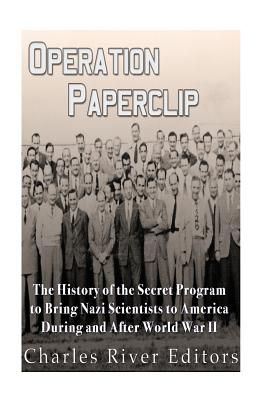
After the last shots of World War II were fired and the process of rebuilding Germany and Europe began, the Western Allies and the Soviet Union each tried to obtain the services of the Third Reich's leading scientists, especially those involved in rocketry, missile technology, and aerospace research. Naturally, this was a delicate affair due to the fact many of the German scientists were not only active Nazis but had helped the Nazi war machine terrorize the world. At the same time, by the late war period, the Anglo-American Allies formed a clear picture of the Soviet state. Though forced to ally with the USSR's dictator, Josef Stalin, the West came to understand Communist Russia represented yet another hungry totalitarian power, and thus a very real threat to an independent Europe. British Prime Minister Winston Churchill realized the menacing character of the Soviets from the Katyn Forest Massacre of Polish army officers, if not before, while the Americans only gradually shed a naïve assumption of continued Russian friendliness after the war. For their part, the Soviets retained ruthless imperial ambitions which manifested in various ways. They allied with Hitler for a time in 1939 to 1941, planning to divide Eastern Europe between their two expansionist states. They devastated the Ukrainian population with the Holomodor, an engineered, genocidal famine which claimed perhaps 3 million victims. The Soviet refusal to evacuate Eastern Europe following the war, instead retaining many formerly democratic countries as vassal states, spoke volumes about their intentions. Both the Western Allies and the Soviets knew of Adolf Hitler's V-2 rocket program, the forerunner of ballistic missiles and the space race. Each recognized the immense strategic value of these technologies and wished to secure their benefits for themselves. As the Soviets contemplated additional expansion following the "Great Patriotic War" and the U.S. military came to understand the putative allies of today would emerge as the enemies of tomorrow, the men possessing knowledge of the V-2 rockets and other Third Reich military technology programs became seen as crucial pieces in the incipient NATO versus Warsaw Pact standoff. The result was the American-led "Operation Paperclip" on the Western side, which resulted in German scientists putting their expertise at the disposal of the U.S. and other NATO members. Operation Paperclip aimed not only to obtain the benefits of German scientific advances for the United States but also to deny them to the potentially hostile Soviets, as General Leslie Groves enunciated: "Heisenberg was one of the world's leading physicists, and, at the time of the German break-up, he was worth more to us than ten divisions of Germans. Had he fallen into the Russian hands, he would have proven invaluable to them (Naimark, 1995, 207).To say Operation Paperclip had a profound impact on the Cold War and American history would be an understatement. The most well known example of the operation's "success" is Wernher von Braun, who was once a member of a branch of the SS involved in the Holocaust, would become known as the "father of rocket science" and fascinate the world with visions of winged rockets and space stations as a "new" Manhattan Project, one that NASA would eventually adopt. And in addition to the weaponization of ballistic missiles that progressed throughout the Cold War, von Braun's expertise was used for America's most historic space missions. NASA also had to develop rockets capable of first launching a spacecraft into Earth's orbit, and then launching it toward the Moon. The Soviets struggled throughout the 1960s to design rockets up to the task, but thanks to von Braun, NASA got it right with the Saturn V rocke

 防詐3要訣:不聽信、不操作、掛斷電話