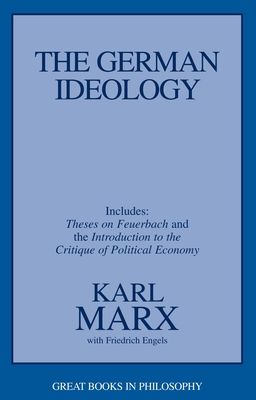
German Ideology: Including Thesis on Feuerbach

German Ideology: Including Thesis on Feuerbach

GERMAN IDEOLOGY

期:
1998/10/31
860
訂單自國外空運,約14-21個工作天(不含例假日)到貨後依序出貨。為縮短等待,建議將此商品和其他商品分開下單。
查詢門市庫存

內容簡介

Nearly two years before his powerful Communist Manifesto, Marx (1818-1883) co-wrote The German Ideology in 1845 with friend and collaborator Friedrich Engels expounding a new political worldview, including positions on materialism, labor, production, alienation, the expansion of capitalism, class conflict, revolution, and eventually communism. They chart the course of "true" socialism based on Hegel's dialectic, while criticizing the ideas of Bruno Bauer, Max Stirner, and Ludwig Feuerbach. Marx expanded his criticism of the latter in his now famous Theses on Feuerbach, found after Marx's death and published by Engels in 1888. Introduction to the Critique of Political Economy, also found among the posthumous papers of Marx, is a fragment of an introduction to his main works. Combining these three works, this volume is essential for an understanding of Marxism.

展開看更多

作者介紹

KARL MARX was born in Trier, Prussia, on May 5, 1818, to an intellectual Jewish family. At seventeen he enrolled at the University of Bonn and a year later transferred to the University of Berlin where he became interested in the philosophy of G. W. F. Hegel. In 1841, Marx obtained his doctorate in philosophy, having presented a thesis on post-Aristotelian Greek philosophy.

As a young graduate deeply involved in the radical Hegelian movement, Marx found it difficult to secure a teaching post in the autocratic environment of Prussian society. In 1842 he became editor of the Cologne newspaper Rheinische Zeitung, but his probing eco-nomic critiques prompted the government to close the publication, whereupon Marx left for France.

While in Paris, Marx quickly became involved with emigre Ger-man workers and French socialists, and soon he was persuaded to the communist point of view. His first expression of these views oc-curred in the Economic and Philosophic Manuscripts of 1844, which remained unpublished until 1930. It was during this brief initial stay in France that Marx became associated with Friedrich Engels.

For his radical political activities, Marx was expelled from Paris toward the end of 1844. He moved, with Engels, to Brussels, where he was to remain for the next three years, except for occasional short trips to England. Here Marx wrote the manuscript for The German Ideology and the polemic The Poverty of Philosophy against idealistic socialism. Marx later joined the Communist League, a German workers group, for which he and Engels were to become the primary spokespersons. In 1847 Marx and Engels were asked to write a mani-festo for the league conference in London. This resulted in the creation of the Communist Manifesto, one of the most influential popular political documents ever written. Its publication coincided with a wave of revolutions in Europe in 1848.

Marx returned to Paris in 1848 but soon after left for Germany, where in Cologne he founded the Neue Rheinische Zeitung, a radical newspaper that attacked Prussian rule. As revolutionary fervor waned, the government suppressed his paper and Marx fled to England in 1849. For the next thirty-four years Marx remained in England ab-sorbed in his work. During this period he composed The Class Struggles in France (1848), The Eighteenth Brumaire of Louis Bonaparte (1948), Grundrisse (1858), Theories of Surplus Value (1860), Das Kapital (Vol. 1, 1867), and The Civil War in France (1871). Karl Marx died in London on March 13, 1883.

FRIEDRICH ENGELS was born in Barmen, Prussia, on November 28, 1820. His father was a very wealthy textile manufacturer who owned cotton mills in both Germany and England. Engels met Karl Marx in Paris in 1844 and soon discovered that they shared similar socialist views. During Marx's lifetime, the two collaborated on a great many projects. After Marx's death, Engels completed the last two volumes of Das Kapital and continued to defend Marxist views.
In addition to Engels's coauthorship of the Communist Manifesto, he produced a substantial amount of independent work: Conditions of the Working Class in England (1845), Anti-Duehring (1878), and The Origin of the Family, Private Property and the State (1884). Friedrich Engels died in London on August 5, 1895.

規格

誠品貨碼 /
ISBN13 / 9781573922586
ISBN10 /
EAN貨碼 / 9781573922586
裝訂 / P:平裝
頁數 / 592
語言 / 3:英文
級別 / N:無
尺寸 / 21.5X14.3X3.0CM
重量(g) / 698.5

退貨說明

退貨須知:

  1. 依照消費者保護法的規定,您享有商品貨到次日起七天猶豫期(含例假日)的權益(請注意!猶豫期非試用期),辦理退貨之商品必須是全新狀態(不得有刮傷、破損、受潮)且需完整(包含全部商品、配件、原廠內外包裝、贈品及所有附隨文件或資料的完整性等)。
  2. 請您以送貨廠商使用之包裝紙箱將退貨商品包裝妥當,若原紙箱已遺失,請另使用其他紙箱包覆於商品原廠包裝之外,切勿直接於原廠包裝上黏貼紙張或書寫文字。若原廠包裝損毀將可能被認定為已逾越檢查商品之必要程度,本公司得依毀損程度扣除回復原狀必要費用(整新費)後退費;請您先確認商品正確、外觀可接受,再行拆封,以免影響您的權利;若為產品瑕疵,本公司接受退貨。

依「通訊交易解除權合理例外情事適用準則」,下列商品不適用七日猶豫期,除產品本身有瑕疵外,不接受退貨:

  1. 易於腐敗、保存期限較短或解約時即將逾期。(如:生鮮蔬果、乳製品、冷凍冷藏食材、蛋糕)
  2. 依消費者要求所為之客製化給付。(如:客製印章、鋼筆刻字)
  3. 報紙、期刊或雜誌。
  4. 經消費者拆封之影音商品或電腦軟體。
  5. 非以有形媒介提供之數位內容或一經提供即為完成之線上服務,經消費者事先同意始提供。(如:電子書)
  6. 已拆封之個人衛生用品。(如:內衣褲、襪類、褲襪、刮鬍刀、除毛刀等貼身用品)
  7. 國際航空客運服務。

若您退貨時有下列情形,可能被認定已逾越檢查商品之必要程度而須負擔為回復原狀必要費用(整新費),或影響您的退貨權利,請您在拆封前決定是否要退貨:

  1. 以數位或電磁紀錄形式儲存或著作權相關之商品(包含但不限於CD、VCD、DVD、電腦軟體等) 包裝已拆封者(除運送用之包裝以外)。
  2. 耗材(包含但不限於墨水匣、碳粉匣、紙張、筆類墨水、清潔劑補充包等)之商品包裝已拆封者(除運送用之包裝以外)。
  3. 衣飾鞋類/寢具/織品(包含但不限於衣褲、鞋子、襪子、泳裝、床單、被套、填充玩具)或之商品缺件(含購買商品、附件、內外包裝、贈品等)或經剪標或下水或商品有不可回復之髒污或磨損痕跡。
  4. 食品、美容/保養用品、內衣褲等消耗性或個人衛生用品、商品銷售頁面上特別載明之商品已拆封者(除運送用之包裝外一切包裝、包括但不限於瓶蓋、封口、封膜等接觸商品內容之包裝部分)或已非全新狀態(外觀有刮傷、破損、受潮等)與包裝不完整(缺少商品、附件、原廠外盒、保護袋、配件紙箱、保麗龍、隨貨文件、贈品等)。
  5. 家電、3C、畫作、電子閱讀器等商品,除商品本身有瑕疵外,退回之商品已拆封(除運送用之包裝外一切包裝、包括但不限於封膜等接觸商品內容之包裝部分、移除封條、拆除吊牌、拆除貼膠或標籤等情形)或已非全新狀態(外觀有刮傷、破損、受潮等)與包裝不完整(缺少商品、附件、原廠外盒、保護袋、配件紙箱、保麗龍、隨貨文件、贈品等)。
  6. 退貨程序請參閱【客服專區→常見問題→誠品線上退貨退款】之說明。
付款/配送

作者相關書籍